Poki Developer Spotlight: No Pressure Studios
Inside the making of Battle Blast, an Unreal Tournament-inspired arena shooter built for the browser.

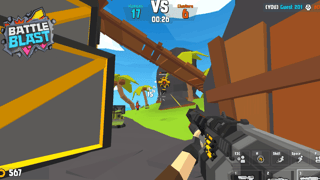
Last month, No Pressure Studios released Battle Blast, a very impressive online multiplayer arena shooter that’s developed exclusively for browsers. It successfully took the core of classic multiplayer games like Unreal Tournament and converted it into a system that takes into account all the aspects of web gaming, from instant play to tab switching, to current online player trends.
There is some impressive tech behind the game and so we sat down with the two Netherlands-based developers behind No Pressure Studios, Steven Derks and Nick Timmer, to discuss the origins of Battle Blast, the challenges of bringing a competitive online multiplayer game to browser and the ethos behind their game design and technological development processes.

You've been releasing games on Poki for over seven years now. So I would like to start by asking for your general thoughts on web gaming itself as a platform for releasing and playing games.
Steven Derks: When we first discovered Poki, we were really surprised at the large audience it had. We came from mobile where it's kind of tough sometimes to attract a lot of people.
Nick Timmer: Especially as an indie dev. In the mobile space, and even on desktop or console, it's quite hard to get your game noticed. The power of web as a platform became apparent to us once we launched our first game on Poki and the traffic just started flowing in. It was just such a huge difference compared to the app stores.
S: Having such a large audience on Poki also made us a little bit more confident that we could experiment and try something new, like a sandbox racing game or first-person shooter.
So let's go even further back. How did you both first meet, set up your company, and decide to become game developers?
S: It was back in 2013. We were working together at a mobile game development studio. It unfortunately went bankrupt, but as we always worked very well together we decided to continue on together and do our own thing. It was a very exciting time because we had nothing else really going on; we were just experimenting with new ideas constantly.
We started with Demolition Derby and thankfully that picked up attention, and we just kept going from there. But we were worried about how insanely competitive the markets were on traditional platforms. You have to basically do what most other developers do to be able to keep your head above water, which kind of works but it's not really exciting.
With Poki, we saw a new venue of actually doing something different and still having an audience. That was basically what kept us moving more towards web gaming, and eventually we said, "Let's just keep doing this and drop the mobile side of things."
That's nice. And so, it's been about seven plus years since you first discovered Poki. How did it first come onto your radar?
N: I'm not even sure how we actually met but I wish we would have known about them earlier, actually. I think maybe Poki reached out to see if we could publish one of the Derby games on their website.
S: Yeah, I think that was it.
N: Yeah. And then we decided, “what if we could do our own thing?” We started with a super tiny HTML game, Stickman Climb. It was just some random experiment, and that basically set it all off.

And now you've got Battle Blast coming up. It'd be good to get some insight into your creative process and how the two of you work together.
N: Our problem is we have way too many ideas (laughs). I think that's basically the same as any indie dev.
S: We have 282 idea cards on our Battle Blast to-do board (laughs).
N: Yeah, it never ends. But most of our games actually start as a small experiment. I'm not really the best coder, but I try to script something very wonky and then I'll show it to Steven. And then if we think it both looks fun, we'll start snowballing and creating something out of it. That's how most of our games start.
N: And that's how Battle Blast started as well. One of the first videos I recorded of Battle Blast shows such a huge difference compared to what the game is right now.
S: You surprised me with that one. I recall I was on vacation and I got a video randomly from Nick. We talked about a multiplayer game and I thought, "Oh, we're going to make Stickman Climb multiplayer." And then he sent me a video: "What if we make a first-person shooter?" Of course, immediately I'm like "Oh, yeah, let's do it!" (laughs).
A first-person shooter is a natural fit on PC, but not one I've seen much in web gaming, at least to the same scope as Battle Blast. It reminds me of old multiplayer PC games like Unreal Tournament. I imagine you're both fans of that game?
N: 100%. We played Quake and Unreal Tournament a lot growing up. Battle Blast started development specifically as an arena shooter for browsers. But along the way, we just decided to rescope and turn it into a long-term investment, building a game that could elevate web games as a whole.
N: And with Battle Blast, we wanted to make a shooter that has the potential to do a lot more. So at its core, it's still the arena shooter, but with a lot of new features to come.
Is it fair to say that this is your biggest project to date?
N: Yeah, 100%.
S: Yeah, by a long shot.
As a game of this scope, and as a multiplayer game, were there any sort of unique challenges and road bumps you hit trying to put this game together and getting it working on web?
S: I think we already touched on one of them: feature creep. It’s an incredible problem. We have so many ideas, so many things we're very excited about, which is great, but it is not great when you want to incorporate all of it into the game right away.
S: It basically turned Battle Blast from a strictly Unreal Tournament and Quake-inspired arena shooter into a slightly more social game, with a social hub area where you can choose a game mode. Digital games can be updated post-launch and so rather than cram everything into one product, we can add new features over time - even stuff that is a little bit different from traditional shooters.

Yeah, you've left it open though to add more content post-launch and to add in some of these ideas that were maybe a bit too much to start with.
N: Yeah, and just to provide a little sneak peek of what’s to come, we’ve already programmed the core of vehicle combat. It's not quite there yet, of course, but we aim to add in the ability to hop in and out of vehicles, kill each other with cars and buggies, and maybe in the future even planes.
S: Unreal Tournament 2004 vibes, that's what we're going for. That was super cool. As for the other challenges, I think the biggest one was the setting up of the network. That’s probably not a surprise to hear — networking is a lot of work. So yeah, that was tricky.
One of our requirements for the network system was to have host migration. If the current host disconnects, the host role goes to someone else. That way, the backend only really has to do matchmaking, connect people together, and try to pick a better host. This benefited us because it meant we didn't have to scale a bunch of game servers, and deal with all the complexity and hosting costs that come with that.
We also had to make a consideration exclusive to web gaming - when you put a tab with a web game into the background, or you play on your phone and lock it, or you swipe your browser into the background, everything just stops. The game doesn't update, nothing happens - basically the player disconnects. We needed a network system that can seamlessly disconnect and continue playing offline, and then later when the player has a connection again it returns to online battles all without the player knowing. That's a requirement that not many network systems really meet, but it was really important that ours did.
The tab problem is something that I hadn’t thought of before. Does it replace the other players with bots?
S: Oh yeah, for sure. Other players disappear and bots will spawn in. We've worked pretty hard on getting the AI to feel challenging, so that the player doesn’t notice they are now battling against the CPU. We can use dynamic difficulty to figure out how good you are at the game, and then the bots can become more challenging and more experienced.

Now that you finally have Battle Blast out there, do you feel that web gaming is a good platform to be having big multiplayer games? Is this something you think you might want to attempt again, maybe in a different genre? Do you think it's something that people would really gravitate to in web gaming?
N: It's quite important to note that the core of the game is fully playable in single-player.
S: Every aspect of the game is playable offline. That was pretty important for us as well.
N: But to answer your question: Yeah, for sure. That's why we went in so hard on the multiplayer tech, so we could reuse it in any of our upcoming, or add to our existing games. One of the ideas we have is to implement it in Fear Response or Crazy Cars, for example. As we said earlier, we have so many ideas.
S: To kind of hook into that, do you know the game Lethal Company?
Yes, I do.
S: I absolutely love that game. It's so much fun. For Fear Response, we want to do a cooperative game mode as well where you can play online, not just the single-player experience. We’re testing it out now and are very excited to see where it might go.
N: Something I noticed from my nephews is that they don't really interact with other people, but they do want to be in an online environment. Like an MMO vibe. It's so important for most kids to feel that they are in a world that's alive and with other people playing it as well. Regardless of the game type, I think the online vibe is so important.
S: You really see that with Roblox and Fortnite. If you add multiplayer to games, it often becomes more fun. It depends on the genre, but we think it makes sense to lean into it.
There's quite a lot of big tech behind this game. How much of this was bespoke for the game and how much was already available?
S: I'll try to keep it short. It was a lot of work. I want to preface this by saying PlayCanvas, the engine we use under the hood, is awesome. The people behind it who build it are doing a fantastic job. They're so helpful; you can directly approach them like, "Hey, there's this thing that we have a problem with, how can we solve it?" and they respond within minutes. It's really impressive. I cannot get the same experience from a lot of other engines.
Of course, it's not a AAA engine; it's not as big as Unity or Unreal Engine. So, we had to build a lot of systems to be able to do what we want. An animation system that can animate anything in the game or in the UI, a virtual camera system, a game mode system, an input system, pathfinding, and occlusion culling. The list really does go on and on. That's also why making Battle Blast took a while, because we have all these requirements for what we want out of a game, and meeting those requirements just requires a lot of building. To not waste our efforts, we want to be able to apply all this technology to all of our games.
So we have our engine built on top of PlayCanvas. We have sort of an opinionated layer we call "No Pressure Sandbox", which is a layer that contains basically everything you need to make an arena game like Team Fortress 2, Counter-Strike, or Halo. It contains playable characters, weapons, vehicles, AI agents, a customization system, loot, and questing. Then we also have just the codebase for the game itself, Battle Blast, which has specific vehicles, weapons, enemy characters, and game modes.
N: You're forgetting about the most important one, Steve: No Pressure Net.
S: Yeah, No Pressure Net is our network system. We built it such that it can interface with any game engine.
Oh, wow.
S: No Pressure Engine uses No Pressure Net, but it can also be used with Unity, if you make a JavaScript bridge. So you can apply it basically anywhere, though our use case is just for Battle Blast right now. That was a really big task. I think it took three years to make, so it was by far the biggest part of the game.
One more thing: unfortunately, PlayCanvas doesn't have editor tools that you can use when running the game. That was pretty challenging because when you build a game, you want to be able to see what's happening when it's running. You can dig through the JavaScript console and try to do it that way, but it's very cumbersome and quite slow.
So, we made developer tools that mimic the PlayCanvas editor and use the same UI system under the hood. But now we have a hierarchy, an inspector, a game view, a scene view - features that are common in AAA game engines. That was a really big advantage that helped a ton. Being able to observe your game and edit stuff while it's running is really helpful. That's something I would love to release at some point because I know a lot of other developers have had this problem as well.

I can imagine that a lot of developers would find that incredibly useful. There's one thing making games, and there's another making entire software and engine-related tools to support it.
So how has Poki themselves supported you throughout all these challenges, both on the design and tech side? I'm curious how much freedom Poki has allowed you and at what points they have come in to support on this project.
N: Poki has always been very supportive in that way. We had regular meetings with them to discuss how progress is going with the game and what kind of tech we are making. Poki’s developer tools are really cool, like the playtesting and the video recording.
N: Yeah, we used it a lot for Battle Blast. Not specifically for the multiplayer testing, but for general gameplay and game testing. We did that a lot actually, and the same for our other games.
S: It's very enlightening to see the results. You're like, "Oh, this is going to be super cool," and then you see people playing the game and doing the exact opposite. A small example—it's really obvious in hindsight—but in Fear Response, we see people walking to the doors of the mansion, the first place you enter, and people are just clicking on the doors. You get a prompt on your screen saying "Press this button to open the door," but people are clicking on the handle of the door. It's like, oh yeah, of course, naturally that's very intuitive, but we're so used to old games like Half-Life where you press E to open the door, so we didn’t even think about another option.
It's very nice to see that someone does it differently, and then you can change your game design accordingly. Like, of course you should be able to touch the handle of the door and open it.
Actually seeing how people play our game is awesome. We don't have dedicated testers ourselves, so it's very nice to be able to have a small piece of the audience test the game for you. I really love that feature.
N: The same goes for the Poki team, right? Because we've done a couple of playtests internally with Poki and that's always very valuable because we get a lot of good feedback from experienced platform users.
S: Yeah, they were like, "Oh, do a playtest," and we were like, "Okay, let's everyone just gather together at the start of the game and then we're going to show you how to..." Nope. Everyone's just spawning in, running everywhere, going through all the portals, and shooting at everything. It was a perfect use case of how real players actually play.
One last question: is there any sort of advice or information on web gaming in general that you think would be super helpful for new developers or developers starting out on the web to know before they start making their first game?
N: The biggest thing we always say to ourselves is that as long as we make a game that we enjoy playing, other people will enjoy it as well. When you make something you enjoy, you put more effort into it. It looks better, it plays better, it sounds better - the game will become better.
S: For sure. If you have fun making it, then you're just going to add more cool features. We’ve also had situations where Nick and I add in a feature that’s exclusively for development purposes but then gets into the final game. That led to us adding in a physics gun and a bunch of other stuff that is really overpowered or silly, but if it's fun, then what's the problem? Just put it in there.
Fun is the point of playing a game, right?
S: Yeah, like why not? And I guess for any new developer it's actually a really good question to ask yourself.
N: Just make a good game.
S: Haha. Yeah. Well, I can at least say this: what I love about web gaming as a platform from a technical perspective is that you don't have to make builds for specific hardware. It is so nice to be able to just make one build and it runs on desktop, it runs on Android, iOS, any tablet, smart TV. I love that part. You can iterate more quickly and you have the Chrome developer tools with which you can profile really extensively and debug stuff.
For that matter, PlayCanvas is open-source, so you can go through all that source code easily. That's not something I could do with Unity unless you have a special partner program.
N: The performance is a downside, though.
S: Yeah, the performance is tricky. With any game development cycle you've got to be very careful, but there are some caveats with web development because it runs mainly as JavaScript and there are some inherent performance downsides to that. It's not going to run as fast as native code, and you've got to be a bit more careful with memory management since there are no custom value types like structs, making pooling essential. Any use of enumerators or temporary object literals in hot paths can also quickly lead to micro stuttering from garbage collection.. So performance is tough; you really will need to spend some time on that probably.
And I imagine Poki also helps quite a bit with getting your game noticed, like the team at Poki or the way the website is structured.
N: Oh, absolutely. Working with Poki is more like a collaboration instead of the App Store approach where it's just you as a developer against the world. The app store is more data and ad-driven to get people into your game, whereas Poki is like a team effort. You get tips and tricks on how to get your game more into the public.
S: You don't get this with the Google Play Store or the App Store.
A big thank you to Steven and Nick for sitting down to speak with us about the development of Battle Blast. We’re always looking for exciting game ideas that really innovate in the web gaming space, so if you have an idea for a game that you want to reach millions of players, reach out and let’s explore your idea together.